

Interview on Big Quali
By Yann Gourvennec of Visionary Marketing (8'40")
When the book Big Quali was released by Dunod in January 2022.
Our QUAL & BIG QUAL study methods
The BigQuali® assessment
Survey + forum + video conferences
Qual: in person and remotely
● In-room focus groups
● Shopper studies
● User testing & ergonomics
● Enhanced video meetings
● Online Qual communities
● WhatsApp forums & auto-ethnography
Qual-Quant® methodologies
● The Qual-Quant® survey
● Speedback® with results in 48 hours
● Recruitment surveys: screening + phoning
● Proprietary access panel
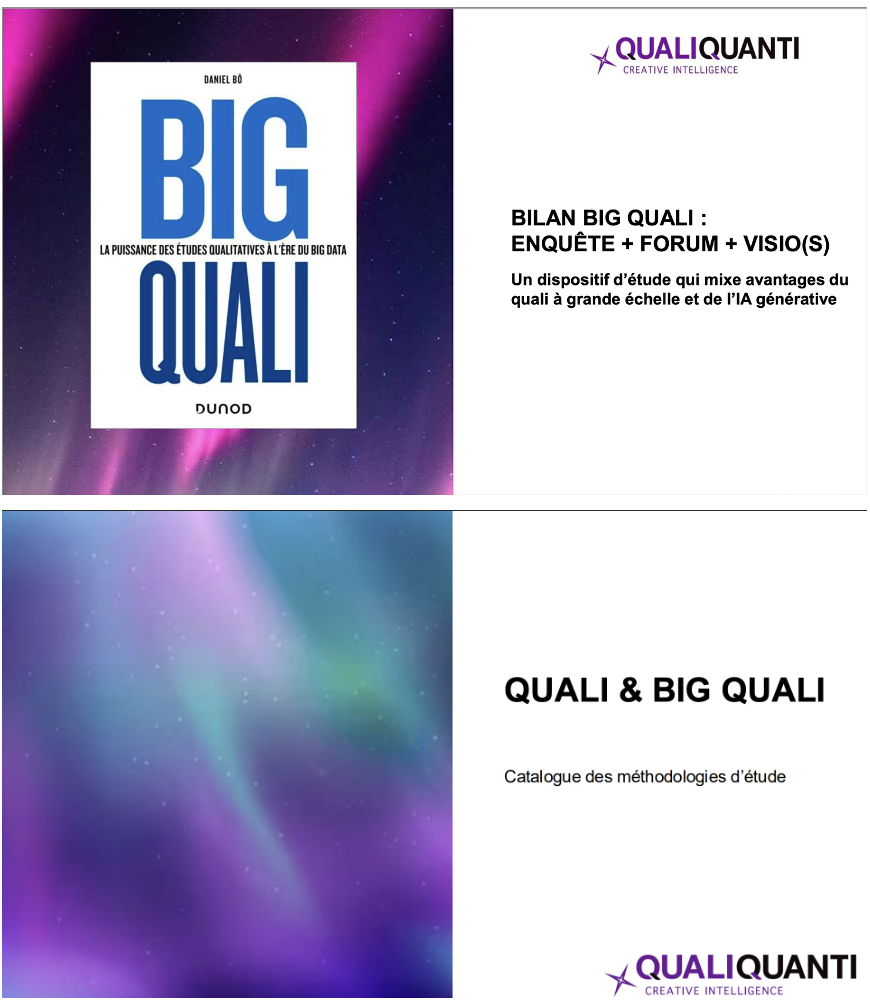
BIG QUAL, large-scale Qual research
Big Qual is about providing an all-encompassing view, a 360° perspective on a topic — within a limited time and budget. It is a powerful way to generate insights that fuel innovation and creativity.

Qualitative research has been enriched by technology (audio, photo, and video recording, software, AI). From self-administered questionnaires to auto-ethnography, let us go through the many advantages of Big Qual.
Ambitious: covering the whole picture
1. Bridging two traditionally opposed worlds
Qualitative research is known for being deep, subjective, and small in scale, while Big Data is massive and statistics-driven. Big Qual aims to reconcile these two universes.
2. Processing massive volumes of qualitative data
This ambition relies on human analysis combined with advanced natural language processing (NLP) tools..
3. Delivering unprecedented granularity and completeness
Big Qual dives into detail while maintaining a comprehensive overview.
4. Real-Time Responsiveness
Collected data can be processed almost instantaneously,making it easier to track longitudinal studies.
At Scale: Achieving Critical Mass
1. Hyperwatch
We consider a complete field of information, where accumulation makes it possible to identify underlying rules:
– In breadth, by building a corpus that covers an entire subject.;
– In depth, by examining all the facets of an object.
2. A systemic approach
The aim of Big Qual is the macroscopic vision (see the work of Joël de Rosnay, The macroscope. Towards a global vision). The objective is to observe:
the infinitely small (in-depth analysis with a microscope),
the infinitely large (synthetic analysis with a telescope),
and the infinitely complex.
3. Quantitative scale
By applying statistical methodologies to qualitative data, Big Qual is able to deliver quantifiable results.
Rich: Detecting Trends & Insights
1. Identifying trends and recurring patterns
When a large volume of data is analyzed, recurring patterns or emerging trends become visible.
2. Amplifying weak signals
A substantial data mass makes it possible to identify weak signals— elements or behaviours that may seem insignificant but, when repeated, reveal opportunities.
3. Highlighting micro-trends
Thanks to the diversity of data, it becomes possible to isolate subgroups or specific segments.
4. Ensuring reliableconclusions
An abundance of data allows researchers to extract the most meaningful elements while filtering out anomalies or less relevant data.
Deep: A Multitude of Perspectives
1. Multiplying data sources
Let's take product pages in e-commerce as an example. To analyze this communication format, Big Qual involves:
– Building an international observatory with several hundred cases, prioritizing inspiring examples
– Analyzing these cases from every angle, while zooming in on original content
– Gathering perceptions from 300 respondents through a semi-open questionnaire, then engaging a community of 20 consumers for three weeks across a wide range of cases
– Drawing on the expertise of around fifteen specialists
2. Semiological and cultural approach
Big Qual integrates cultural and semiological analysis tools to explore the meanings, symbols, and codes present in the discourse and content. This allows us to understand not only what is expressed, but how and why it is conveyed.
See: How does Big Qual help you multiply your research angles?
Our Blog on large-scale qualitative studies

Discover examples of large-scale qualitative studies and methodological insights on Bigquali.com
The impact of AI on qualitative studies
Discover our white paper which illustrates how AI enriches the potential of qualitative studies and Big Qual.
AI: What added value?
Digitalization has made it possible to move from a handcrafted approach to large-scale exploitation unstructured data – testimonials, photos, videos. This is the essence of Big Qual. With AI, the large-scale use of qualitative data is becoming widespread.
AI not only delivers productivity gains, but also enables deeper analysis, discovery, and creativity. Some current innovations with AI include: :
- Developing AI-friendly interrogation techniques, requiring structured responses and a critical mass of data.
– Creatingdedicated AI agents to extract, analyze and process qualitative data.
– Using collaborative documents with real-time analysis allowing studies to be tracked live.
– Strengthening self-administered contributions (forums, auto-ethnography, reactions to stimuli) to enrich AI datasets.
AI Gives Qualitative Research New Wings
AI is transforming qualitative research by:
– Putting recruitment and fieldwork quality at the heart of the study: the reliability of AI processing depends entirely on the quality of the data it is given to analyze.
– Answering simple questions through systematic analysis, reinforcing the objective dimension of qualitative research.
– Freeing up time for greater creativity, depth, improvisation, observation, and exploration from multiple angles.
– Encouraging two-tier deliverables: :
. High-level syntheses with strong creative, cultural, and human added-value.
. Comprehensive working documents, with all field data classified and analyzed with AI support.
To fully harness the power of AI, qualitative research must evolve from a handcrafted approach to Big Qual.
Our creative approach to research
Creative intelligence is an analytical process that explores unexpected and inventive ways to generate original and relevant solutions. Learn more.

Solving complex problems
Ability to think differently: breaking out of traditional patterns.
Multi-perspective approach: integrating various points of view (consumers, cultural trends, markets)
Stakeholder involvement: promoting better ownership by involving teams (clients, agencies, consumers) in the creative process.
Adapting to change
Contextual approach: integrating the cultural, economic and social context, it delivers insights that are both relevant and aligned with contemporary realities.
Varied techniques: combining tools such as crowdsourcing, online communities, cultural monitoring, collaborative workshops, and semiological analysis to enrich the research.
Enriching marketing insights
More inspiring results: delivering rich findings expressed visually.
Semiological monitoring: drawing on a fine-grained analysis of cultural and visual signifiers to capture emerging trends.
Pragmatism: providing practical, directly applicable solutions.
Predictive capacity: integrating detected trends and weak signals.
Developing innovative Strategies
Fostering innovation: by stepping off the beaten track, helping brands put forward original solutions.
Co-creation: encouraging the inclusion of diverse ideas to develop solutions that are both rich and relevant.
