

This blog will be an opportunity to share our thoughts and sources of inspiration. At QualiQuanti, we view research as a source of creativity and a means of uncovering insights.
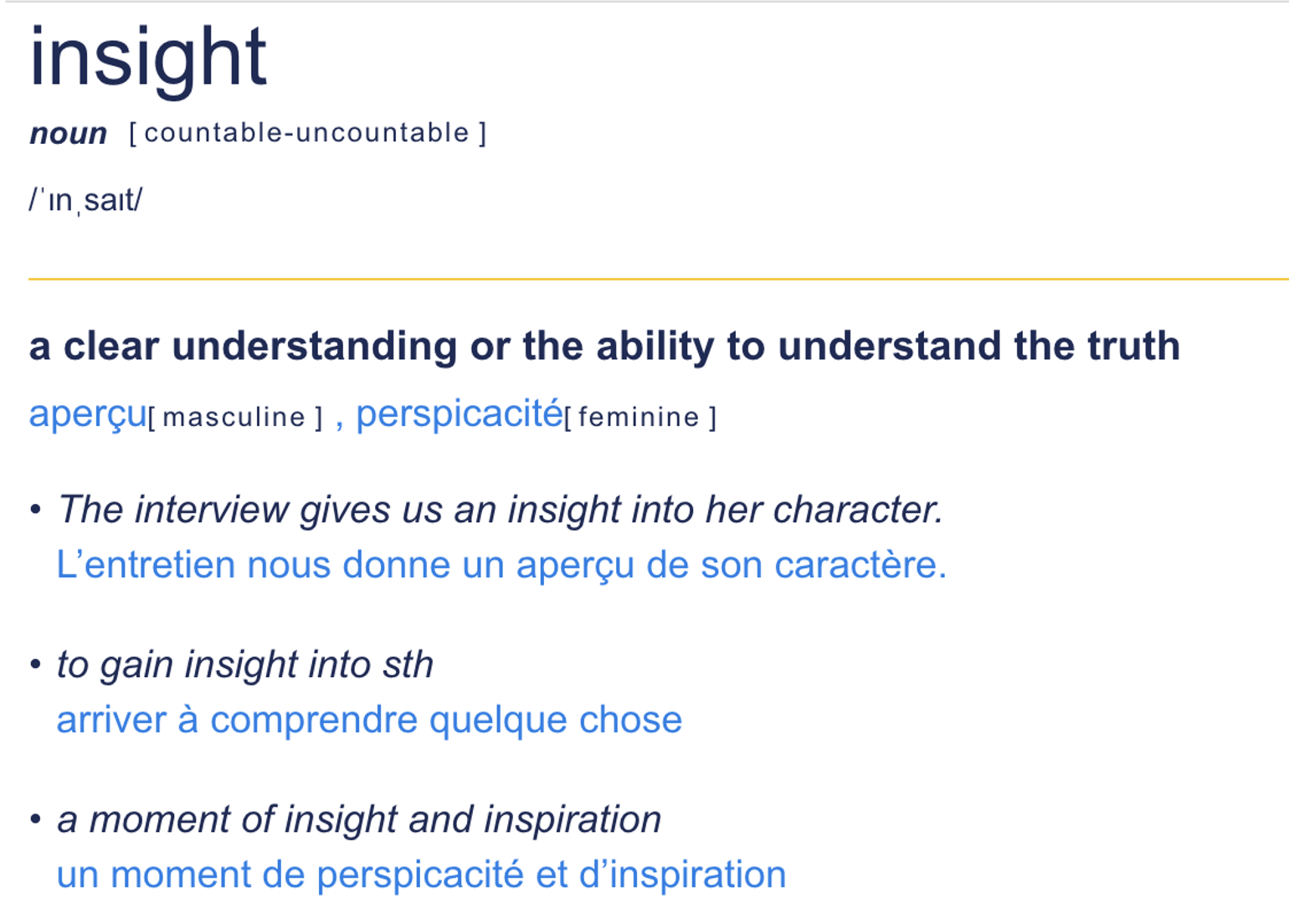
Insight refers to the notion of truth-seeking, sagacity, perspicacity, and inspiration. It is very close to two notions at the heart of QualiQuanti:
- Creative intelligence: https://testconso.typepad.com/marketingetudes/creative-intelligence/
- Performativity: https://www.qualiquanti.fr/wp-content/uploads/2023/07/performativite.pdf
In this blog you will find a series of methodological reflections and inspiring study results.
Here are different approaches to identifying insights:
- Observe with sagacity and insight / inspiration : see the concept "Hyperwatch"
- Identifying nuggets and smart solutions
- Empathize (opinion, experimentation and auto-ethnology)
- Explore in depth by multiplying the angles
- Analyze pain points (transform seeds into nuggets)
QualiQuanti at the service of creative intelligence
A research institute and laboratory, QualiQuanti chose in 2014 to position itself under the banner of "creative intelligence," an inventive and evolving approach to foster the creation of original and relevant solutions. We chose this baseline as the best possible expression of our research approach and our daily work. We will detail this philosophy below.
At QualiQuanti, we refuse to mechanically apply closed and immutable processes, preferring interdisciplinarity and flexible methodologies, and harnessing the creative potential of studies to generate inspiring, stimulating, and meaningful results. To this end, we adopt a series of biases that aim to increase the fluidity of research approaches, increase its adaptability to varied problems, and blur the line between the rational and the imaginary.
Cultural vs. Bureaucratic Approach
The lack of originality and innovation in many of the study results is due to the overuse of so-called "bureaucratic" research methods, to use the term used by Douglas Holt and Douglas Cameron in their analysis of "Brand Bureaucracy."
These are:
- on the one hand, to use standardized analysis tools (concepts, processes, methodologies, etc.) and presentation tools (simplifications, keywords, etc.) to simplify and schematize reality in order to make it more easily appropriable, according to a reductive approach which does not adapt to different realities;
- on the other hand, to promote Cartesian, even pseudo-scientific approaches, leaving little or no room for irrational arguments, emotions, human beings, etc., in a lack of consideration of what makes a brand unique, what generates attachment to a product, notions which are nevertheless at the heart of marketing.
Taking into account the context of the object of study
At QualiQuanti, we believe, on the contrary, that the creation and consumption of brands are profoundly cultural acts, and we approach their study as such.
For us, a "cultural" approach means an intelligent approach that does not analyze objects only for themselves but places them in their historical, social, cultural, competitive, etc. context. The characteristic of culture is that it is a multi-dimensional and evolving field that cannot be divided into watertight slices, all of whose aspects are articulated without any one being able to ignore the others.
Tailor-made methodologies
This approach requires a rejection of standards, schemes and prefabricated methods that apply identically in each study in favor of a tailor-made approach.
Faced with a constantly evolving reality on the ground and multidimensional brands, we believe that research institutes must evolve their methodologies. To enable us to grasp the complexity of this multidimensional reality and to best adapt to the specificities of our clients, we favor lightweight, multiple and easy-to-combine systems: qualiquanti® studies, crowdsourcing, cultural and semiological analysis, semantic and sound analyses, large-scale international monitoring with a strong visual dimension, research on atmosphere and multi-sensoriality, etc.
Inductive vs. Deductive Approach
At QualiQuanti, we recognize the impurity of studies and accept the idea supported by the "Bourdieusians" of a foggy or inexact science, while knowing that a good methodological combination allows us to define a subject and master its ins and outs. Thus, we defend an inductive and pragmatic approach starting from data from the field, to go back to theory.
By definition, the inductive approach starts from observations to lead to the formulation of a hypothesis or a model. It is therefore a generalization to a class of objects of what has been observed in a few particular cases. The basic idea of this conception is that the regularity, the repetition of a phenomenon increases the probability of seeing it reproduce itself, without the truth of the conclusion being absolutely assured. This reasoning is opposed to deduction, which starts from a statement, a theorem or a verified principle from which one deduces valid results only to the extent that the initial axiom was correct.
This approach is by far the most suitable (or even the only possible) for an empirical science like marketing. Since John Stuart Mill, two types of sciences have been distinguished: deductive sciences, which are based on intrinsic logic (mathematics, theoretical physics, etc.); and inductive sciences, which concern the external world.
The “hyperwatch”
Who says inductive approach says "critical mass": it is about considering a complete field of information whose accumulation will allow rules to be generalized:
- in breadth, with the constitution of a corpus that goes beyond the strict field of analysis of the subject: we seek to understand and analyze everything in order to cover a subject. We aim for an ideal of omniscience or omniknowledge, in order to offer the most refined understanding possible of a complex and polymorphous reality.
- in depth, with the consideration of all the facets of an object. In doing so, we are in line with the scientific method which proceeds by modifying one of the variables of the object of study. This approach has been theorized by phenomenology, which speaks of "eidetic" variation (of eidos, in Greek the Platonic idea) to signify that the phenomenon emerges in its essence when one or more of its dimensions are varied. Since the essence is never totally realized in each incarnation, the observation of a single case is not enough: it is the monitoring of the totality of the variations which allows one to acquire a perfect and complete knowledge of the object, and to identify its elements of force, that is to say those which are constant.
When analyzing a theme, we therefore favor large corpora highlighting the variety of places (intercultural studies), temporal developments, etc. Among the processes that we use to construct an omniscient point of view, we can cite:
− The creation of very comprehensive benchmarks, thanks to very large-scale monitoring combined with in-depth and systematic semiological analysis: we have thus decoded in great depth the grammar of film posters and trailers, TV sets, advertorials, TV sponsorship and luxury codes, etc.
− The 360° investigation methodologies made possible by long-term online quali which allow testing corpora of more than a hundred stimuli (see our intervention at IREP on quali 360 consumer centric Or brand centric)
From induction to conceptualization
The QualiQuanti method does not stop at induction results: it combines observation, inductive generalization of cases and conceptual problematization.
The semiological method plays a large part in this: it attempts to link empirical observations to theoretical issues (philosophical, sociological, ethnological, semiotic, etc.) that allow them to be armed and conceptually grounded. In doing so, we move away from the accumulation of descriptions of successive cases to unify the results in a single analytical impulse and identify their salient and new elements. The result is not only generalization, but the conceptualization of issues that cut across a subject of study.
This methodology induces:
− Reading reference books on the subject covered and the importance of documentary research
− Collaboration with experts with a very broad general culture (Raphaël Lellouche is the first among them) in order to mobilize encyclopedic knowledge.
− The mobilization of these experts in the form of an interconnected network with a logic of regular exchanges
Holistic vs. focused approach
At QualiQuanti, we advocate a holistic view that understanding a topic goes far beyond analyzing each of its individual parts. We believe that issues should not be viewed in a narrow sense, and that the answer to a question can lie outside of a preconceived notion. More than a narrowly focused result, we believe that a study is a collection of results that are intricately interconnected.
To clarify these articulations and find the right scope, one solution is to multiply approaches and points of view. Thus, our vision is not the simple juxtaposition of results but the intelligent and organic combination of skills and tools. The recently developed Cultural Research methodology makes full use of these properties.
Surveyability
The inductive method involves analyzing a phenomenon by observing a cluster of similar, more or less similar manifestations that bear a family resemblance to it. By multiplying the objects of study, it allows for an overall view, a global understanding of a subject, as if one had a bird's eye view. This ability is what we call "surveyability."
A heterogeneous corpus
Following Paul Willis's lead, who encouraged the analysis of life as a "work of art," we strive to consider the smallest facets of a subject, without any preconceived hierarchy.
This approach can lead to the creation of a corpus that is heterogeneous from an ontological point of view (different media formats, objects, atmosphere, sensory elements, semiotic codes, etc.) but which, when grouped together, reveal a stylization of the modes of creation by brands or consumption.
Breaking down barriers between disciplines and tools
The name QualiQuanti provides the most obvious example of the breaking down of barriers between methodologies: it was chosen to express the idea of a simultaneously micro and macro investigation, of an understanding that is both very in-depth AND on a large scale. The novelty of our approach lies in the AND. Most institutes juxtapose quantitative and qualitative methods, without truly combining them: in quali, we prohibit ourselves from having large samples; conversely; in quantanti, the investigations can remain superficial, due to the simplistic and mechanical nature of the questionnaires.s closed used.
In addition to these methods of analysis, which are certainly mixed but traditional, there is the almost systematic use of human and social sciences: semiological analysis of corpora, mobilization of general culture (philosophical, sociological, historical, artistic, etc.) of experts, comparative and relative analysis based on benchmarks and inspiring monitoring, etc.
The study on connected television carried out for the CNC, by combining semiological analysis, qualitative testing and physiological study of relationships with screens, is a good example.
The semiologist, a “hyper-interpreter”
The ideal, normative hyper-consumer, capable of embracing everything, seeing everything and understanding everything, does not exist: as human beings, each of us always has a perspective, a point of view.
In this respect, semiology, while not the holder of an objective truth, allows this bias to be minimized by providing a more guaranteed, more complete, and less partial interpretation than that of any consumer. The semiologist, while remaining an interpreter like any other receiver, is a sort of ideal interpreter thanks to his very broad culture and his mastery of the theories underlying each subject. His competence is not different in nature from that of the consumer, but is taken to the limit because it is cultivated, intense, and systematic, capable of considering concepts in their entirety.
Collective intelligence and multiplication of perspectives
Over the years, we have founded a structure based on collective intelligence, which allows us to have a holistic and organic vision of thetogether of a given subject.
To understand this, let's take the metaphor of how a beehive works: each bee occupies a specific position and role and works to serve the hive as a whole. In isolation, each contributes to the best of their abilities to form a whole that is completely beyond them. With the web, the notion of global collective intelligence has developed among humans, which is distinct from original intelligence and pyramidal intelligence (hierarchy, division of labor).
Similarly, at QualiQuanti, we operate with collective intelligence at several levels:
− In space: we work in a network and remotely (teleworking). We don't need to be all together in the same room. We are spread out in space (and therefore not limited), but interconnected (via the Internet and document sharing). We meet when collaboration in a face-to-face mode makes sense: for example, for a Semio-live, an interactive semiological analysis session.
− Over time: each article or project that we carry out collectively works in layers where each invested collaborator successively brings their perspective and skills;
− In terms of skills: we multiply the stakeholders on the projects according to their expertise (under the leadership of a director of studies). Each contributes collectively to the enrichment of the project, the report, the article, to the extent of their skills (quantitative and qualitative analyst, semiologist, art historian, ergonomist, musicologist, philosopher, etc.).
Thanks to the synthetic reappropriation of all points of view on the subject, and the creative leap that is made by this reappropriation, the director of studies is able to provide a complete (totality) and dynamic overall vision of the subject investigated.
Lightweight vs. monumental devices
Taking the opposite view to many research institutes that offer monumental systems spread over several weeks or even months and involving very large budgets, QualiQuanti favors "light" systems (10 days in the field maximum) with several advantages:
− Speed of implementation and achievement of results.
− The acquisition of an overview, a synthetic global vision thanks to the mixing of all the data over very short periods of time. In this respect, Sémio-Live ®, which manages to analyze a very large corpus in one day, is a model of concentration.
− Easier appropriation of results by the study managers in charge of the analysis, then by the clients.
Capitalizing on expertise vs. naivety
At QualiQuanti, we leverage our knowledge of a subject to gain breadth and depth of vision as well as efficiency.
The analysis over the years of hundreds of subjects concerning very varied issues and sectors constitutes a "cultural background" that each new study reactivates, confronts, consolidates and enriches in a permanent updating. In particular, the constant exercise of semiology is conducive to the mobilization of knowledge and the development of links and bridges between the subjects.
Capitalizing on memory through consultants
In addition to knowledge acquired through experience, prior general culture is the essential reference universe for contextualizing and understanding complex issues.
This is why QualiQuanti encourages versatility in its employees, a fundamental feature of recruitment and management within the organization. Many research officers hold degrees in both marketing and human sciences (art history, philosophy, sociology, etc.), and are employed to carry out various missions (quali, quanti, semiology, brand culture audit, monitoring, etc.), sometimes combined for the same account.
Data libraries
The acquired knowledge is consciously archived and organized, with:
− The creation of a study database similar to what we do on the Brand Content : the idea is to accumulate a series of studies on a multitude of subjects with progressive consolidations.
− The conscious and organized capitalization of our research work over the past 35 years.
A self-critical and evolutionary approach
One of the fundamental concepts of modern epistemology is that of the evolution and revisability of scientific theory: in opposition to religious dogma, which is revealed and unfalsifiable, scientific theory adapts to reality and evolves according to discoveries, allowing revolutions (such as the transition from Newton's physics to that of Einstein, for example).
At QualiQuanti, we never adopt a learned and definitive point of view on things; each article, each project that we carry out collectively is a " work in progress » which we are committed to continuously improving.
More broadly, each research project is a new opportunity to question the relevance of the method and the result. This ongoing self-criticism leads us to constantly renew our methodologies to adapt both to the ever-unique demands of our clients and to our changing environment.
Studies as the basis of a creative philosophy
We design our studies not only as decision-making tools but also as creativity boosters. In an increasingly complex and changing competitive environment, the sustainability of companies is directly linked to their ability to innovate.
Our studies are sources of inspiration to help our clients understand who they are, where they are and to open up the field of possibilities by awakening them to realities previously ignored. They allow us to help brands identify trends and new opportunities (investigation territories, modes of communication and consumer relations, etc.) that are innovative but consistent with their brand culture and capable of resonating with consumer expectations and the major trends in our societies.
Inspiring results
We see studies as a means of stimulating innovation.
− Far from being the presentation of a contemplative knowledge of a subject, our study results are operational and rich in creative potential: they perceive unexploited potential, understand deep trends, and are concretely a force of suggestion in the service of marketing decisions. In this respect, semiology has the value of a creative matrix: it constitutes the fundamental analysis grid of an object whose cursors then only need to be moved to have a projective dimension in the future.
− We want our study results to be able to generate an emotional as well as a rational anchor: to create surprise, to make the study an appropriate experience thanks to inspiring and lively, exciting reports, constructed not only as a discursive accumulation of recommendations but integrating images, video, etc.
A search for meaning
Our studies don't just provide raw results for a specific issue, but also seek to put them into perspective, both in relation to a context and in relation to the internal coherence of the brand. We aim to help brands make more sense to their consumers.
It is this desire that is at the origin of our brand culture audits, which take into account in the study of the brand:
- The traditional analysis of the signs emitted by the brand: elements of brand identity (logo, name, signature, visual codes, history, etc.), history of the brand and corpus of communication, but also objects, people, gestures, stories, atmospheres, techniques, shapes, noises, colors, etc.
- The cultural contexts in which it is immersed and evolves, its cultural fields of reference.
The intersections of these two analyses allow us to deduce the nodes formed between the signs emitted by the brand and its cultural reference fields. These nodes form as many paths, guidelines that allow us to help brands implement a cultural strategy that is at once specific to the brand, coherent and authentic.
A pioneering dimension
QualiQuanti stands out in the market for its extremely proactive approach. More than just providing standard recommendations, it's about formulating a vision of a market and imagining tomorrow's trends through a comprehensive process of multidisciplinary research and analysis.
What is true for each subject of study is also true for marketing in general. Thus, innovative concepts such as Brand Content or, more recently, Brand Culture have been introduced in France by QualiQuanti.


One response
Hi, this is a comment.
To get started with moderating, editing, and deleting comments, please visit the Comments screen in the dashboard.
Comment avatars come from Gravatar.